
Book design
A reader’s route through an ebook
Make chapter links, note journeys and other navigation reflect the structure readers actually encounter.
Book design
Describe the information an image contributes, with enough context to make it useful in the book.
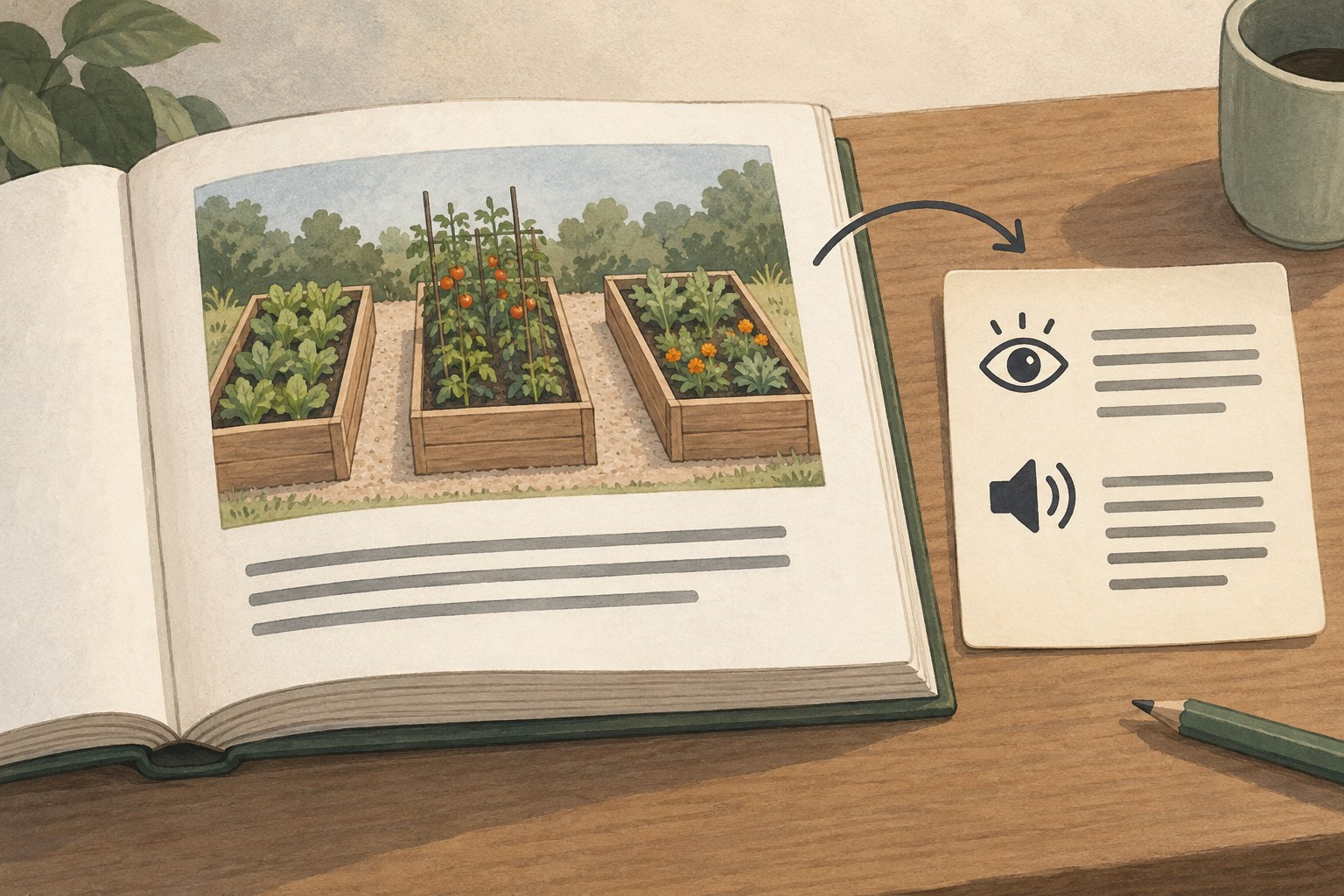
An image description begins with an editorial question: what would the reader miss if this image were unavailable? The answer depends on the passage around it. The same photograph might illustrate a building's façade in one chapter and the location of its entrance in another. A useful description follows the purpose of that particular use.
Do not begin by inventorying every visible object. If an illustration explains how two parts connect, the relationship matters more than the colour of the workbench. If a photograph supports a discussion of colour, then colour may be essential. Context determines which details deserve words.
W3C's image guidance distinguishes informative images, decorative images and complex images, among other cases. This is a useful starting point for deciding whether a short alternative, a longer explanation or no additional description is appropriate. It is not a reason to assign one stock sentence to every image in a category.
Imagine a diagram of three planting beds separated by narrow paths. If the chapter concerns access, a description might explain the arrangement and the path widths. If the chapter concerns crop rotation, it should identify which crops occupy which beds. The visual object is identical; the information needed to understand the passage is different.
Keep a short description concise without treating a fixed character count as the goal. Name the important subject early and then explain the relevant action or relationship. Avoid vague judgements such as “a beautiful illustration” unless the judgement itself is part of the discussion. Do not infer emotions, identities or causes that the image does not establish.
Separate what is visible from what is known through the caption or research. A photograph may show a person holding a notebook; it does not, by itself, prove that the person is the author of the book under discussion. Descriptions should not introduce unsupported information just because it seems plausible.
A chart with several series may need an explanation of the trend and access to the underlying values. Cramming a dense table into a single short description can be exhausting to hear and hard to navigate. Consider a nearby text explanation or an accessible data table, depending on the publication format and the image's purpose.
Coordinate captions and descriptions. Repeating the caption verbatim may add little, while leaving out necessary context can make the description confusing. Read the surrounding paragraph, caption and description as a sequence. Each should contribute something useful without making readers encounter the same information repeatedly.
Descriptions can disappear or attach to the wrong object during conversion. Check the exported ebook or other digital edition using an appropriate accessibility inspection method, and include meaningful images in assistive-technology testing where possible. A field filled in within the source document is only the start.
When images change, review their descriptions too. A tighter crop may remove an object named in the original text. A revised chart may change the trend. Keep the description with the image's production record so that it is treated as part of the content, rather than an optional label added after the book is finished.