
Writing
Bring a question to a writing group
A focused question helps a writing group describe its reading experience and keeps the discussion useful to the next revision.
Writing
Tell a reader what stage the draft has reached, what you need to learn and what kind of response would help.

A useful feedback request begins before the manuscript attachment. State what you are sending, why this version is ready to read and what you hope the response will illuminate. A reader reviewing an early chapter should know whether you expect changes to the whole structure or are trying to settle a few local uncertainties.
Limit the request to questions the reader can answer from the material provided. If you send only the opening, they can describe their expectations and points of confusion. They cannot reliably tell you whether the ending satisfies the book's promises. Provide the necessary context or narrow the question.
Try asking for the reading experience before asking for solutions. “Where did your attention slow?” or “Which step in this explanation required a second reading?” gives you evidence to investigate. “How would you rewrite this?” can be useful later, but it may replace your problem with the reader's preferred approach too soon.
Include any genuine constraints. Perhaps the piece has a fixed audience or must preserve a particular example. Explain those limits briefly. Do not turn the request into a defence of every choice. Readers still need permission to tell you when something inside the stated constraints does not work.
Agree on a reasonable format and date if the reader is willing. A short conversation, a page of notes or comments on three marked passages may be enough. Asking for a complete line edit when you mainly need to know whether the argument is convincing can waste effort on sentences that will later disappear.
For example, an author might write: “This is an early chapter for readers who have never kept a household budget. Please mark any term you cannot understand from context, and tell me whether the worked example makes the final step clear. I am still revising the order, so sentence corrections are optional.” The request identifies the reader, the stage and the decisions at stake.
When the response arrives, read it before arguing with it. Ask follow-up questions about ambiguous observations and thank the reader for the work involved. Keep responsibility for the revision yourself. Feedback becomes usable when you connect a reader's experience to a deliberate change in the manuscript.
Writing
A focused question helps a writing group describe its reading experience and keeps the discussion useful to the next revision.
Writing
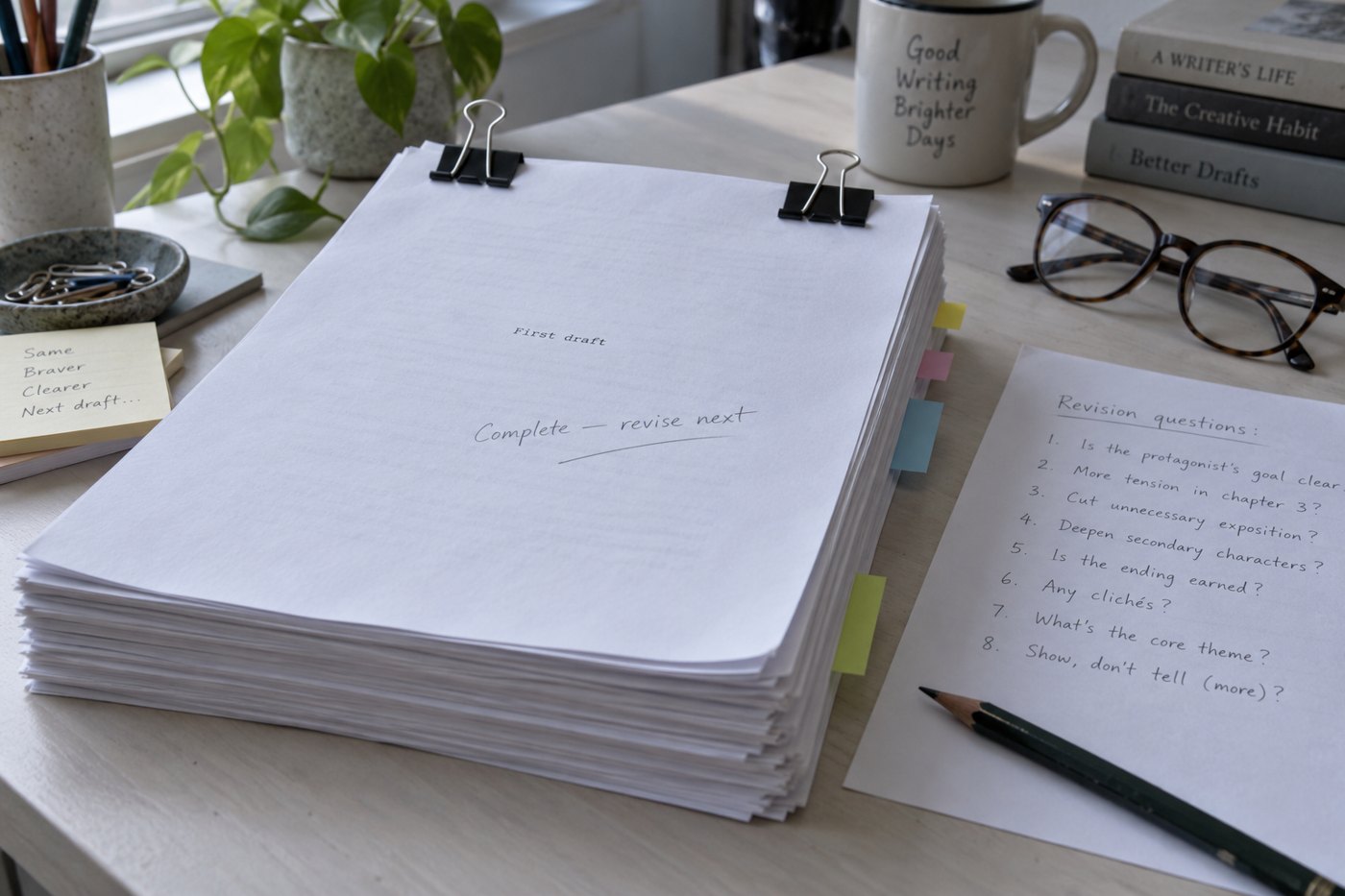
A first draft is complete when the whole work can be read and assessed, even though many local decisions remain provisional.