
Writing
Choosing who tells a scene
Choose a viewpoint for what it lets the reader experience, including the information it keeps beyond reach.
Writing
Narrative distance changes the reader’s closeness to a character’s experience while the viewpoint can remain the same.
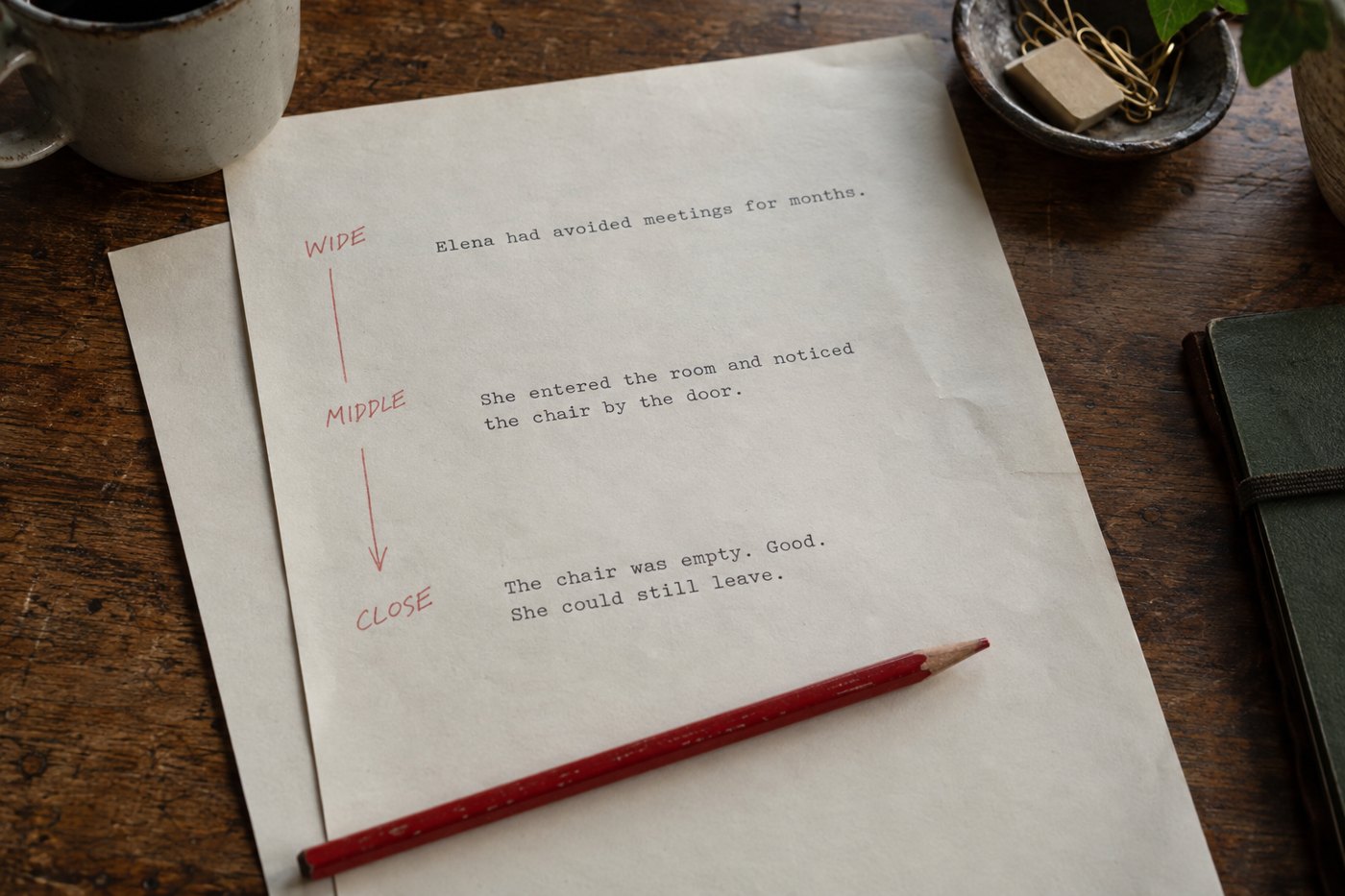
'Elena was anxious about the meeting' reports an emotional condition. 'The chair beside the door was still empty. Good. She could leave before anyone noticed' moves nearer to Elena's moment-by-moment attention. Both passages can belong to a third-person narrative limited to Elena. The difference is how directly the prose presents her experience.
At a greater distance, a narrator can summarise a period, explain a habit or place an event in context. Closer narration often gives more space to the details and language the character would use at that moment. Neither distance is automatically better. A book needs room to pass over uneventful weeks as well as to dwell inside a difficult second.
Choose distance according to the work of the passage. If the reader needs to understand that Elena has avoided meetings for months, summary may be efficient. If the reader needs to feel her weighing the door against the empty chair, move closer. Changing distance is a way to distribute attention, not a requirement to make every sentence intensely immediate.
A sudden plunge from broad history into a character's private idiom can feel abrupt if nothing connects the levels. Use an object, action or perception as a bridge. You might move from the history of a neglected hall, to Elena entering it, to the smell of damp upholstery, to her thought that the room has not changed since childhood. The narrative narrows around what she encounters.
Closer prose need not include a constant stream of 'she saw', 'she felt' and 'she thought'. If Elena is the established viewpoint, the reader will usually understand whose perception the empty chair belongs to. Removing some filtering phrases can bring the experience forward. Keep them when the act of noticing or reconsidering is itself important.
The character's vocabulary can also colour the narration. Someone who repairs furniture may notice a loose joint where another person notices an ugly chair. The detail does two jobs: it locates the scene and gives the character's attention a particular shape. Avoid giving every character the same catalogue of lyrical observations.
After an intense moment, a wider sentence can restore context. Elena leaves the room; the narrative can then summarise the uneventful journey home. Readers do not need an equally close account of every staircase and bus stop merely because the meeting was close. A change in paragraph or scene can help establish the new scale.
During revision, mark a passage as wide, middle or close. Look for movement that serves the scene and movement that happens accidentally. A sentence explaining Elena's personality in general may interrupt a moment that otherwise stays inside her immediate uncertainty. Conversely, sustained close detail may slow a passage whose only job is to connect two important events.
Read the passage aloud without the distance labels. The goal is not perfect uniformity. It is an intentional rhythm of approach and release that lets readers know when to observe the character and when to experience the moment alongside her.