
Writing
Working out why the middle has stalled
A stalled middle often points to a missing consequence, a repeated obstacle or a goal that no longer asks enough of the character.
Writing
A chapter ending controls a pause. Choose the pause for the question or consequence you want readers to carry forward.
A chapter can contain one scene, several scenes or a stretch of summary. Its boundary does not have to coincide with the end of an event. Think instead about the unit of attention: a request and its answer, an investigation and a new discovery, or a period of waiting that finally changes into action.
Summarise the chapter's movement in one sentence. If the sentence requires several unrelated clauses, the chapter may contain more than one useful unit. If it describes only arrival and preparation, the main action may still lie in the next chapter. These are clues rather than rules. Long preparations can carry pressure, but their purpose should be visible.
A boundary can give a moment weight simply by allowing a pause after it. A character saying 'I already knew' may deserve the space that a chapter break creates. Adding another page of explanation could reduce the effect. Conversely, breaking immediately before every answer can teach readers that the book keeps interrupting itself to manufacture suspense.
Different endings leave different kinds of energy. An unanswered question creates anticipation. A completed action can invite reflection. A small detail can change the interpretation of the chapter. A decision can redirect the next section. Choose the effect that belongs to the material rather than making every ending imitate a cliffhanger.
Look at the final paragraph separately. Does it repeat a conclusion the scene has already made clear? Does it explain an emotion the reader has just experienced? Sometimes the strongest ending is a few lines earlier, before the narrator begins summarising the significance of the event. Sometimes the opposite is true: the scene needs one quiet consequence after the dramatic line.
For nonfiction, the pause should help readers recognise what has been established and what remains to be examined. A chapter on the limits of a method might end with a case that the method cannot explain. The following chapter can then address that problem. Avoid promising a revelation on every final page if the next chapter simply continues ordinary explanation.
A chapter ending cannot be judged entirely alone. Put the final paragraph beside the opening of the next chapter. If both explain the same transition, one may be redundant. If the new chapter changes time, place or viewpoint, supply enough orientation for the reader to recognise the shift without rereading the previous ending.
Check a run of chapter lengths too. Uniform length is not a requirement. A shorter chapter can emphasise a decisive event, while a longer one can sustain an unfolding encounter. But an isolated short chapter may feel accidental if it contains only information that belongs naturally elsewhere.
Try moving a questionable break by a page in either direction. Read each version aloud or in a different display format. The experiment is cheap, and it often reveals where the prose has already prepared a natural pause. Keep the boundary that supports the movement of thought and feeling through the book.
Writing
A stalled middle often points to a missing consequence, a repeated obstacle or a goal that no longer asks enough of the character.
Writing
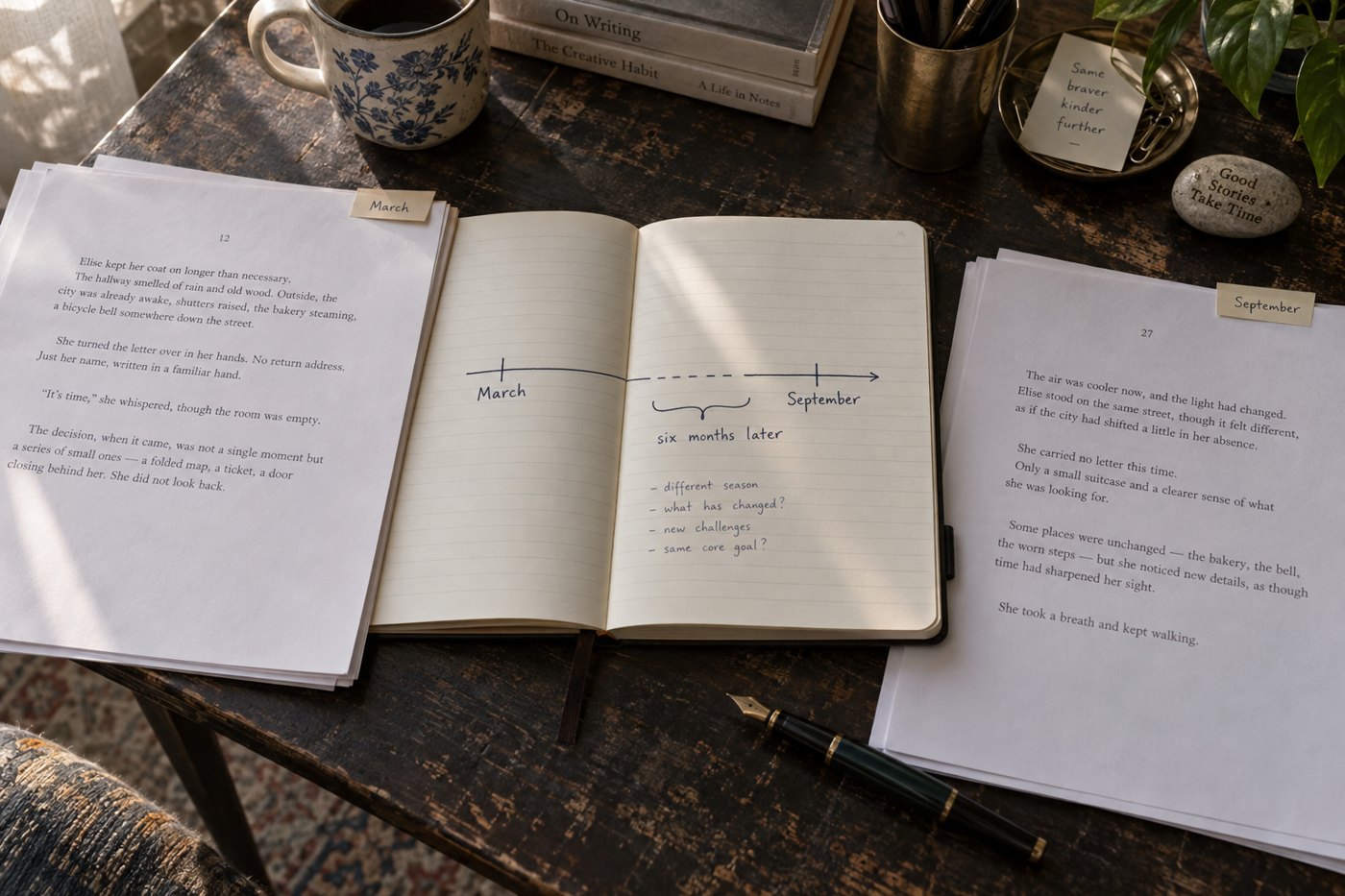
A time jump can leave events behind while giving readers enough bearings to understand the new present.