
Editing
Find repetition that weakens an argument
Repeated wording is easy to spot; repeated argumentative work requires a closer look at what each passage contributes.
Editing
Paragraph order becomes easier to judge when you examine the job of each block before revising its sentences.
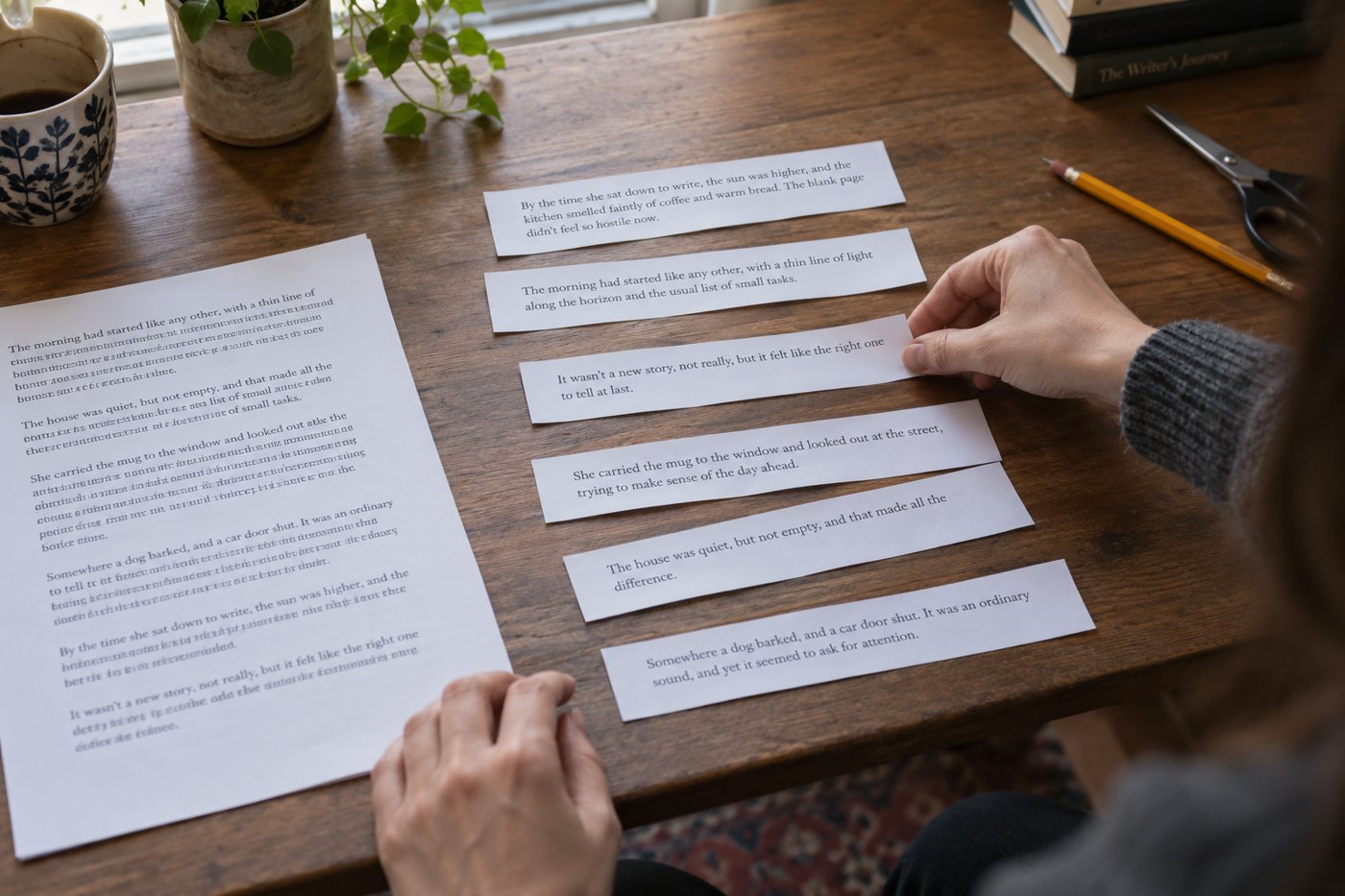
A paragraph can be clear and still occupy the wrong place. It may explain a term after the reader has struggled with it, introduce an exception before establishing the rule or answer a question the preceding material has not yet raised. Polishing its sentences will not resolve that sequence.
Make a short label for each paragraph on a copy of the draft. If a physical version helps, print the passage with space between paragraphs and cut it into separate strips. You can also move blocks in a document or outline. The method matters less than being able to compare arrangements without losing the original.
Label functions rather than topics. “Cost example” is less revealing than “shows why the cheaper unit price does not produce the cheaper total”. A useful label records the contribution and makes dependencies easier to notice. If a paragraph has two unrelated jobs, it may need to split before the order can become clear.
For an explanatory passage, ask what the reader needs to know before each new step. A definition may need to precede the worked example. A qualification may make more sense immediately after the claim it limits. A recommendation usually needs enough context for the reader to understand why it fits the stated problem.
Consider an invented article about comparing printing quotations. One paragraph gives the final comparison, another explains what each quotation includes, and a third warns that delivery costs differ. Placing the inclusions and delivery distinction before the numerical comparison may allow the reader to evaluate the result as it arrives. The conclusion then has a visible foundation.
Other forms can benefit from a less direct order. A personal essay may begin with an image and reveal its significance later. A story may withhold an explanation to preserve the viewpoint character's uncertainty. Test whether the delay creates the intended experience or merely prevents the reader from understanding what is happening.
Try more than one arrangement when the answer is unclear. Read only the labels first, then read the full paragraphs in the most promising order. A sequence that looks logical in outline can still feel awkward in prose because the paragraphs carry assumptions from their former positions.
Check words that depend on location: “therefore”, “however”, “again”, “this” and “the following”. Each should express the relationship that now exists. Do not retain a transition simply because it sounded fluent before the move.
Watch for information introduced twice, references whose subjects have moved and examples separated from the claims they support. You may need to rewrite a paragraph's opening or closing sentence. Make those changes after the main arrangement is stable enough to judge.
Finally, read the passage without its temporary labels. The reader will never see your notes or the paper strips. The order should make the movement of thought available through the prose itself, with enough guidance to follow and enough space to think.