Editing
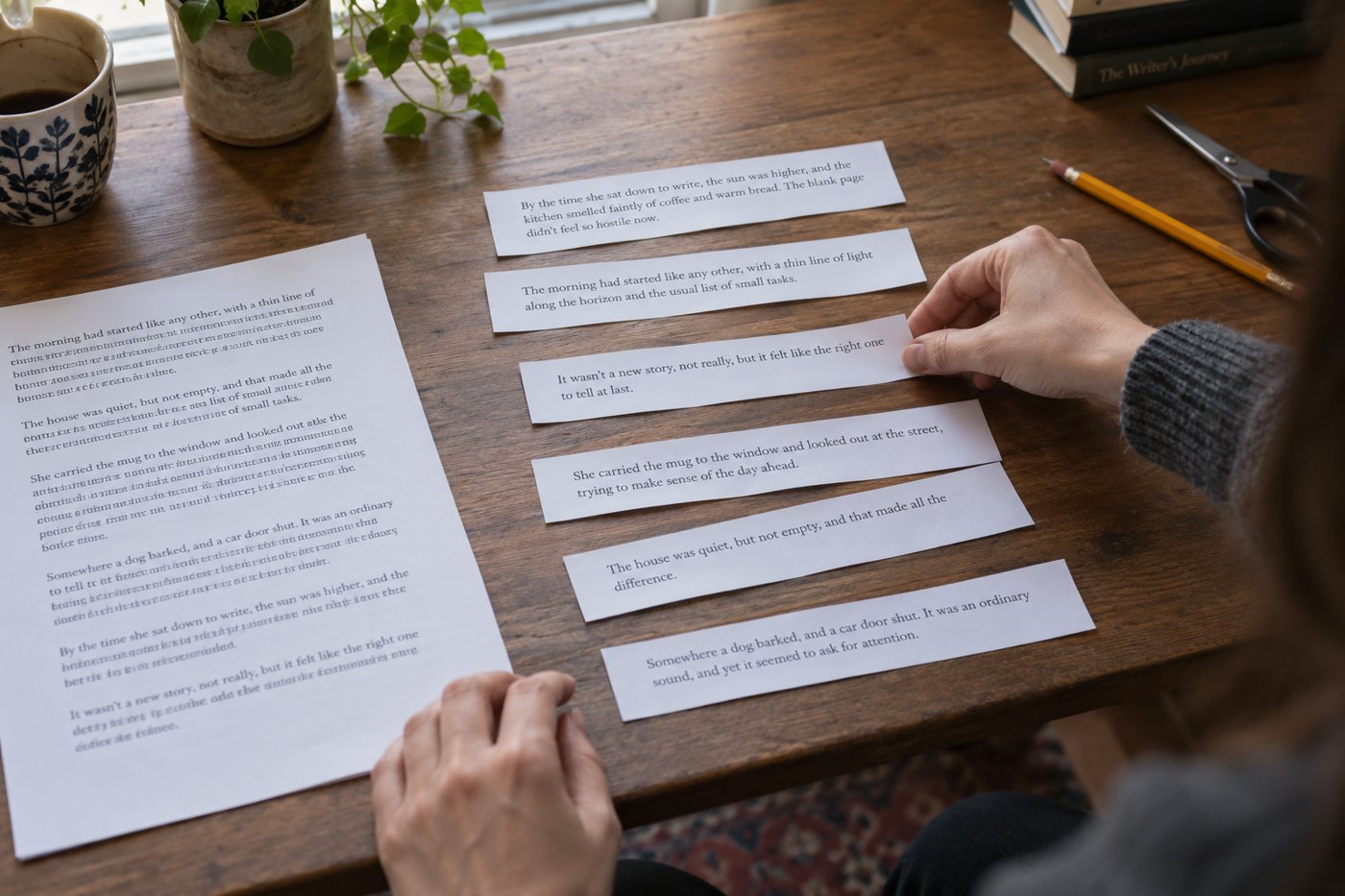
Rearrange paragraphs before polishing them
Paragraph order becomes easier to judge when you examine the job of each block before revising its sentences.
Editing
Sentence rhythm comes from the movement of thought as well as the length of the lines on the page.

A paragraph can feel monotonous even when its sentences are grammatically sound. The cause may be a repeated pattern of openings, an unbroken run of similar clauses or important words buried in the same weak position. Read the passage slowly enough to notice how each sentence approaches and leaves its main point.
Consider an invented description: “The hallway was empty. The lights were dim. The door was open. The room was silent.” The repeated structure could produce a deliberate, measured approach. If that effect is unintended, combine or vary the observations according to what matters: “Beyond the dim hallway, an open door revealed a silent room.” The revision changes pace and focus, so it should be judged against the scene's purpose.
Short sentences tend to receive emphasis when they interrupt a longer movement, but a paragraph made entirely of short sentences can flatten that contrast. Longer sentences can carry qualification, association or accumulation. Their usefulness depends on whether the reader can follow the relationship among the parts, rather than on an ideal word count.
Look at the ends of sentences. A significant image or decision can lose force when followed by a trailing explanation that the reader already understands. Try moving the emphasis to the end, or ending earlier, and listen to the difference. Keep the longer version when its qualification is necessary to the meaning.
Varying sentence length mechanically can produce artificial prose. Instead, ask what kind of attention the paragraph needs. A complicated distinction may require a carefully linked sentence and then a brief statement of its consequence. A sequence of rapid actions may benefit from fewer interruptions. A reflective passage may need room for a thought to turn.
Check repeated openings and connective phrases. Several sentences beginning “There is” may postpone the subjects that deserve attention. Repeated “however” or “therefore” may signal that the relationships need to be made clearer in the wording itself. Removing those phrases is useful only if the logical connection remains available.
Read changes in context. An elegant sentence can disrupt the voice or pace of the surrounding paragraph. A fragment may work in an intimate first-person account and feel misplaced in a precise procedural explanation. The appropriate rhythm belongs to this narrator, subject and reader.
Finally, leave some repetition when it carries intention. Parallel structure can make a comparison easier to grasp, and recurring phrasing can connect moments separated by many pages. Listen for whether the repeated pattern gathers meaning or merely repeats a habit.
A good rhythm pass produces a few consequential changes rather than a new sentence shape everywhere. Stop when the thought moves clearly, the emphasis falls where you want it and the prose still sounds like the work you are writing.
Editing
Paragraph order becomes easier to judge when you examine the job of each block before revising its sentences.

Editing
Reading aloud can expose awkward movement and missing words, provided you listen to what is written rather than silently repairing it.